How Long Does Intermittent Fasting Take to Work? The Real Timeline
Most people see something in 2 to 4 weeks. Most of week one is water. The honest, week-by-week timeline backed by clinical trials — not Instagram before-and-afters.
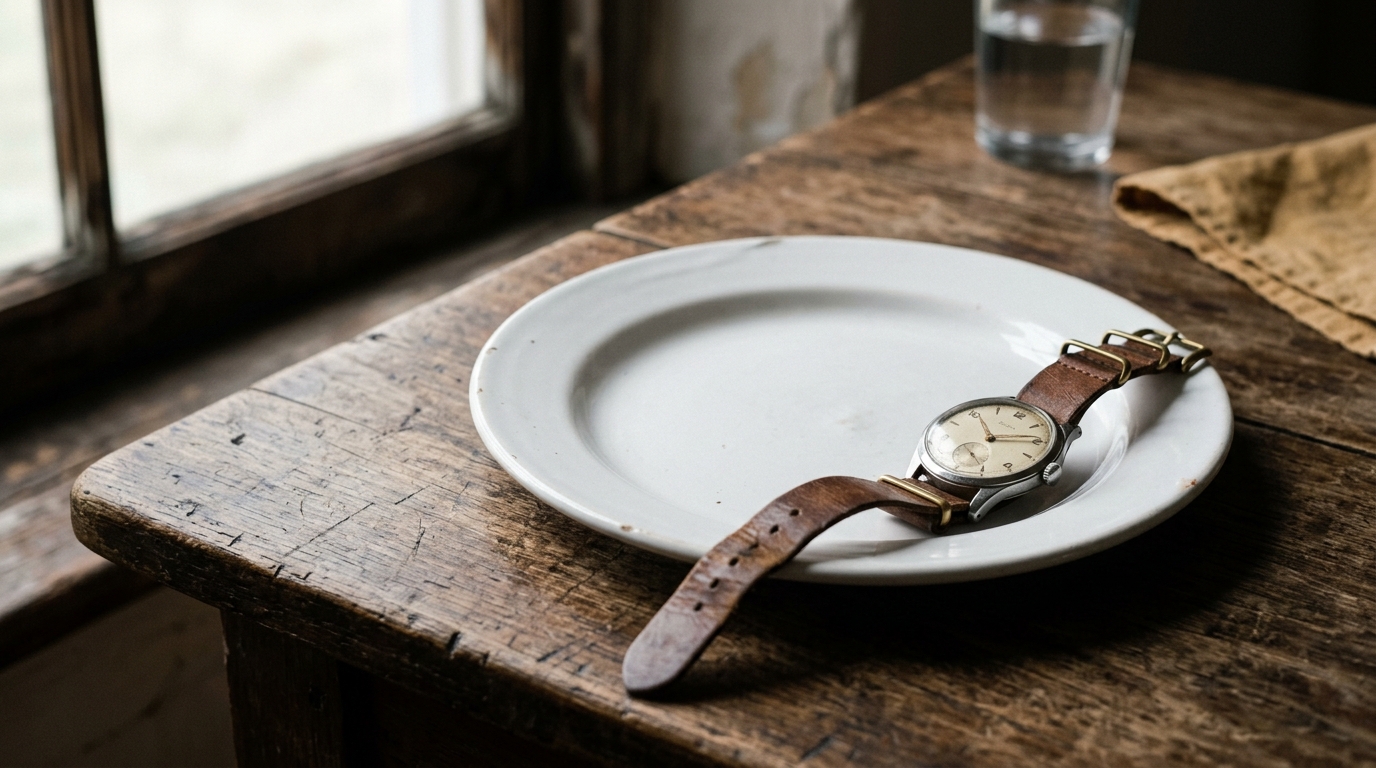
Intermittent fasting typically shows scale movement in 2 to 4 weeks. The first week is mostly water and glycogen — about 2 to 4 pounds of non-fat loss. Steady fat loss of 0.5 to 1 lb per week shows up at week 3 onward, assuming a real calorie deficit. A 2020 trial in JAMA Internal Medicine on 16:8 fasting found about 2 pounds more weight loss than control over 12 weeks. Insulin sensitivity improves earlier — within 4 to 8 weeks per Sutton et al., Cell Metabolism 2018.
The short answer
Intermittent fasting is not faster than regular calorie restriction. It is, for the right person, easier to stick to. That distinction matters. The published research is consistent: fasting protocols and traditional calorie counting produce similar weight loss when calories are matched. What fasting does well is reduce the daily decision count — fewer meals, less snacking, easier compliance. That's a behavioral advantage, not a metabolic one.
The honest timeline is 2 to 4 weeks for the first signal, 8 to 12 weeks for results that look like the protocol is working, and 3 to 6 months for the kind of body composition change that people notice. If you're a week in and disappointed, you're not broken — you're early.
What the science actually says
Does intermittent fasting actually work for weight loss?
Yes — about as well as continuous calorie restriction. A 2020 randomized trial in JAMA Internal Medicine by Lowe et al. compared 16:8 fasting to a regular three-meals-a-day eating pattern in 116 adults. The fasting group lost about 2 pounds more over 12 weeks — statistically significant but small. A 2022 meta-analysis in Nutrients covering 11 trials found similar: roughly 1 to 4 percent body weight reduction over typical 8 to 12 week trials.
The mechanism is calorie reduction by structure. When you compress eating into 8 hours, most people naturally eat 200 to 400 fewer calories per day without explicit tracking. That's the deficit. The fasting itself doesn't have a unique fat-burning effect — it just makes eating less, less effortful.
How long until insulin and metabolic markers shift?
Faster than the scale. Sutton et al. published a landmark 2018 trial in Cell Metabolism using "early time-restricted feeding" (eating between 8 a.m. and 2 p.m.) in 8 men with prediabetes. After 5 weeks:
- Insulin sensitivity improved significantly
- Beta-cell responsiveness improved
- Blood pressure dropped
- Oxidative stress markers dropped
All of this happened with no weight loss in the 5-week protocol. The metabolic changes preceded scale changes. That's a meaningful finding for anyone with insulin resistance — the protocol is doing useful work even when the bathroom scale isn't showing it yet.
What about muscle loss during intermittent fasting?
A real concern that is mostly avoidable. A 2016 study in the European Journal of Sport Science by Moro et al. on resistance-trained men following 16:8 fasting for 8 weeks found:
- Fat mass decreased significantly
- Lean mass was preserved
- Strength was maintained
The condition: enough protein during the eating window and continued resistance training. We cover the protein math in our creatine and body composition piece. Skip the protein or skip the gym, and the muscle-loss concern becomes real.
What's the dropout rate on intermittent fasting?
Higher than people admit. Most published trials report 20 to 35 percent dropout over 12 weeks. The Mayo Clinic's review of fasting protocols specifically notes that the difficulty of sustaining a fast is the most common reason people quit. The more aggressive the schedule (5:2, alternate-day), the higher the dropout.
The real week-by-week
What actually happens if you start a 16:8 fast tomorrow:
- Day 1 to 3: Hunger spikes around your old breakfast time. Headaches possible. Energy uneven. Most people feel "fine" by 11 a.m. Drink water and black coffee. Hydration matters more than usual.
- Day 4 to 7: Hunger waves smooth out. Cognitive performance returns. Glycogen-bound water leaves — 2 to 4 lb scale drop. This is not fat loss yet.
- Week 2: Routine becomes easier. Some people feel sharper in the morning fasted. Cravings drop in the afternoon.
- Week 3 to 4: First real fat loss signal — 0.5 to 1 lb per week if calories are right during the eating window. Clothes start fitting differently around the waist.
- Week 5 to 8: Insulin sensitivity improvements show up in lab work for those with prediabetes. Energy stabilizes. Most people stop tracking the clock and just eat in the window naturally.
- Week 8 to 12: Total weight loss of 4 to 10 lb is realistic. Body composition has shifted. The protocol has either become a habit or you've drifted off it — most quit happens here.
- Month 3 to 6: Plateau period. The body adapts. You either tighten the deficit, raise activity, or accept maintenance. See our piece on realistic monthly weight loss.
When intermittent fasting actually works
- You're a chronic snacker. If most of your overage is mindless eating between meals, a fixed window cuts the opportunity. Highest-leverage use case.
- You hate counting calories. A time-based rule replaces a math-based rule. For people who give up on tracking, this can be the simpler structure that works.
- You have insulin resistance or prediabetes. The Sutton 2018 work shows real metabolic benefits independent of weight loss. Worth discussing with your doctor.
- Your evenings are eat-out social. A 16:8 window that starts at noon and ends at 8 p.m. lets you keep social dinner and skip the breakfast you didn't really want.
- You can lift 2 to 3 times per week and prioritize protein. This is the configuration where body composition improves, not just scale weight.
When intermittent fasting won't work
- You overeat in the window. The most-common failure mode. A 1,200-calorie lunch and a 1,500-calorie dinner is still 2,700 calories. The window doesn't override the math.
- You have a history of disordered eating. Strict eating windows can trigger restrict-binge cycles. The American Psychological Association recommends caution. Talk to a clinician first.
- You're underweight or trying to gain muscle aggressively. Compressed windows can make hitting calorie and protein targets harder.
- You're pregnant, breastfeeding, or under 18. Most fasting protocols specifically exclude these populations. Don't run this protocol.
- You're on insulin or sulfonylureas. Hypoglycemia risk during the fast is real. Doctor-supervised only.
- You quit at week 2 because you "didn't see results." See above — you're early.
How to actually run intermittent fasting
- Pick the simplest schedule. 16:8 with a 12 p.m. to 8 p.m. eating window works for most schedules and lifestyles.
- Don't ramp aggressively. If you currently eat from 7 a.m. to 9 p.m., move your breakfast to 9 a.m. for a week, then 11, then 12. Build the habit, don't shock it.
- Hit your protein. 0.7 to 1.0 g per pound of bodyweight, split across 2 to 3 meals in the eating window.
- Lift 2 to 3 times per week. Preserves muscle, drives the body composition change.
- Walk daily. See our steps-per-day piece — the calorie burn stacks with the fasting structure.
- Track for the first 14 days only. Just to confirm you're actually in a deficit during the window. Then stop tracking and follow the structure.
- Run it for 12 weeks before judging. If you lose 4 to 10 pounds and feel sharper, it's working. If you lose nothing, the calories are wrong.
Tools that help: our calorie deficit calculator for the first two weeks of confirmation, and our 7-day meal plan for two-meal-a-day templates.
FAQ
When does intermittent fasting start working for weight loss?
Most people see scale movement within 2 to 4 weeks if they're in a real calorie deficit. The first week's drop is mostly water and glycogen — 2 to 4 pounds is normal and not fat. Real fat loss shows up as a steady 0.5 to 1 lb per week from week 3 onward, assuming the eating window is calorie-controlled.
How long does it take to lose 10 pounds on intermittent fasting?
At a sustainable rate of 1 to 2 pounds of fat per week, 10 pounds takes 5 to 10 weeks. Faster than that is mostly water. A 2020 JAMA Internal Medicine trial found 16:8 fasters lost about 2 pounds more than control over 12 weeks — modest, not dramatic. The fasting structure helps adherence; the calorie deficit does the work.
Why am I not losing weight on intermittent fasting?
Three usual reasons. First: you're eating maintenance or surplus during the eating window — the fasting structure doesn't override calorie math. Second: it's been less than 3 weeks and you're impatient. Third: stress and poor sleep are elevating cortisol and offsetting the deficit. Track calories honestly for 7 days before assuming the protocol is broken.
What's the best intermittent fasting schedule for fast results?
16:8 is the most-studied and most-sustainable. Eat in an 8-hour window, fast for 16. Skip breakfast, eat lunch and dinner. Aggressive schedules like alternate-day fasting drop weight faster but quit rates are much higher. The schedule that works is the one you can do for 12 weeks straight.
How long does it take for intermittent fasting to lower insulin?
Fasting insulin starts dropping within 24 to 48 hours of starting a daily fasting window. Meaningful, lab-detectable improvements in insulin sensitivity show up at 4 to 8 weeks in published trials (Sutton et al., Cell Metabolism 2018). For most people, this matters more than the scale — better insulin sensitivity makes future weight loss easier.
Will I lose muscle on intermittent fasting?
Not if you eat enough protein — 0.7 to 1.0 g per pound of bodyweight, distributed across the eating window — and you keep training. A 2016 study by Tinoco-Veras et al. found that 16:8 fasters who lifted weights lost fat without significant lean-mass loss. Skipping protein and skipping the gym is what costs you muscle, not the fasting per se.
Can I drink coffee, tea, or water during the fast?
Yes. Black coffee, plain tea, water, and unsweetened sparkling water are universally allowed during the fasting window. Anything with calories — milk, cream, sugar, juice, soda — breaks the fast. Most clinical protocols allow zero-calorie beverages without restriction.
Read more on Real Easy Diet
- How much weight can you lose in a month?
- How many steps a day to lose weight?
- Does creatine help you lose weight?
- How much water should I drink to lose weight?
- A 7-day Real Easy meal plan
- Calorie deficit calculator
- Which diet matches your life?
Sources
- Lowe DA et al. — 16:8 vs three-meals trial, JAMA Internal Medicine 2020
- Sutton EF et al. — Early time-restricted feeding and insulin, Cell Metabolism 2018
- Moro T et al. — 16:8 in resistance-trained men, JTM 2016
- Mayo Clinic — Intermittent fasting overview
- Harvard Health — Intermittent fasting update
- Johns Hopkins Medicine — Intermittent fasting explainer
A printable plan that refuses to count almonds.
Four-week schedule. Grocery list. Swap rules. No "fat-burning loophole." No app to download. You print it, you stick it on the fridge, you eat real food.
- 4-week schedule
- Grocery PDF
- Swap rules
- No app, no fees